Showing posts with label Pre-production. Show all posts

What Producers Want?


Here area my findings..
  • Producers always, always looking for the hook
  • Producers looking for big idea, universal/wide appeal, driven by great characters 
  • Each produces have own background and interest - this to lead various genre. 
  • Some maybe like original story, and maybe some like to experiment with adaptation (from a novel or just from an article he/she just read, for example).
  • There area producer with passion/interest (ie. science, history, politic-drama, etc.) or maybe just plain business (following the trend and make money -- like it's a supply-demand kinda business? Really?)
  • Most producers already have several idea in their head.
  • Decision could be from one producer or maybe more.
  • Making big decision - take the script to big screen or, just to local tv drama channel instead.
  • Producers already have a list of screenwriters to work with and love.
  • Producers don't really know about scriptwriting (technically) as they always refer to proposal and synopsis to evaluate


Producers expectation from writers
  • capability to write particular genre
  • meeting and discussion among screenwriter/producer/crew - sharing idea
  • writer with his/her own style, taste and maybe concern
  • into the near of present tense, shorten the descriptions, and externalize/express visuals
  • deliver the material as planned
  • flexible in changing/re-write script

<<more inputs to be updated along the way..>>


,

Script Breakdown Process

Role: SCRIPT SUPERVISOR (who will assist the Director)

Task (in general)

  • a personal checklist that covers all
  • to make sure everyone brings the things they need to bring
  • start figuring out what equipment and sets and wardrobe and special effects and visual effects and locations and makeup and so on
  • considering production schedule and budgeting
  • are familiar with essential props  
  • filtering how many characters need to be cast
  • knows what the sets, locations, props, and wardrobe are supposed to look like
  • key grip know what the lighting and composition and colors are supposed to look like
  • special or visual effects are planned for and designed in advance
  • goes through the script page by page with highlighters of various colors - representing the concerns of a specific department, and highlights passages to be extracted - standard for which color highlighter - such as ‘locations’, ‘props’, ‘equipment’, and ‘special/visual effects’

Sample from script

INT. SHOP - NIGHT

ED, a fifty-year old car salesman, enters his shop with a LOADED REVOLVER and a SUICIDE NOTE. His shirt is stained with tears. He sits at his cluttered desk and sets the note on his computer. The gun goes off, spraying the window behind him with red.

get ready for Location : GREEN
PROP MASTER to get ready for Props : YELLOW
ART DIRECTOR to get ready for Equipment : BLUE
VISUAL EFFECT SUPERVISOR to get ready for Special/Visual Effect : ORANGE
get ready for Wardrobe : PINK

All is about to express the character, situation, condition and background. And all above affect the budget.

Also, worth reading.. 
, , , , ,

Membina Sinopsis Skrip

Contoh Synopsis Template from WikiHow
Maksud "Sinopis" = huraian ringkas = a brief summary or general survey of something. 

Basically (based on WikiHow), ada a few points perlu highlight dalam membina sinopsis.

a) Judul cerita yg menarik
  • perlu diubah, jika perlu
  • sertakan genre
b) Tulis Logline

  • buat 2 ayat yg describe the whole story; yg catchy
  • aku rasa, sini le tpt highlight the hook
c) Perkenalkan main character
  • dalam 1 perenggan
  • Include the names (who), their occupations (what), where they live and work (where), the time period of the story (when), and the reason you are telling their story (why)
  • Nama character dgn HURUF BESAR on first time intro. 
  • Character termasuk protagonis (hero), antagonis (villain). Yg tak berapa penting, may skip
d) Huraian Act 1
  • dalam 3 perenggan
  • huraian berkaitan setup
  • perkenalan character, konflik
e) Huraian Act 2
  • dalam 2-6 perenggan
  • info ttg konflik dan halangan yg menyebabkan krisis
f) Huraian Act 3
  • dalam 2-3 perenggan
  • huraian penyelesaian konflik 
  • huraian apa yg jadi pada character slps itu 
g) Contact info
  • nama, alamat, contact no, email address

More Info:
  • anggaran sinopsis dalam 1 mukasurat saja 
  • mungkin sesetengah pihak (seperti producer, agent, produksi) menghadkan bil. perkataan dan/atau bil. mukasurat
  • minta org lain baca sinopsis utk check penjelasan boleh difahami atau tidak. Kalau tak jelas, update.


Contoh Sinopis Star Wars


, , , , , ,

Proses Pitching

Pitching definition from Wikipedia

Based on multi-source of reading..including wikipedia "Pitch (filmmaking)"; apa yang aku faham tentang pitching ni adalah..
  • persembahan IDEA secara lisan ataupun visual oleh pihak A kepada beberapa pihak B untuk menarik perhatian dan meraih kontrak perjanjian penyiaran (terutamanya penyiaran drama atau tele-movie di televisyen)
  1. pihak A (team presenter) - penulis skrip, penulis lakon layar, pengarah, penerbit ataupun produksi
  2. pihak B (evaluation panel) - financier/investor, editor, eksekutif produksi, ketua penerbit mahupun agent, pelakon atau krew
  • tempoh persembahan: 15-20 minit. Lebih dari itu, crap!
  • assumption: proposal dan skrip telah dibekalkan (in advance) kepada pihak evaluation panel

Jika skrip dan proposal dibuat untuk dijadikan filem, proses pitching melibatkan; I think; writer dan produksi as people from produksi yang akan work on the fund (finding investor); and later establish the taskforce untuk hire-team, marketing, promotion, etc.

So, the real player in film/drama industry could be production house, tv, or investor - the business people with money. Meaning, kalau tiada proses pitching ni, tiada la business transaction. Really?


TEAM PRESENTER
  • Team Presenter mesti
  1. good communicator sebab dealing dengan business people
  2. ada strong foundation knowledge tentang IDEA yang hendak dipersembahkan; and also, mentioning the hook
  3. sediakan beberapa maklumat tambah seperti laporan, news-clip, people behind the story, interviews, etc. - buat research anything related.
  4. hurai sinopsis skrip/cerita (secara lisan) kepada evaluation panel dalam 2-3 ayat saja - padat, ringkas dan jelas. Huraian lanjut (dalam 10 minit), perlu penuh minat dan yakin
  5. tahu dan fokus pada setiap perincian cerita - mula, tengah dan akhir, karaktor, plot, konflik - all inside out
  6. ada maklumat tentang latarbelakang hasil karya lain yang berkaitan termasuk untung rugi, rating, liputan media, etc.
  7. beretika, properly groomed (tampil formal) as it is really a business relationship in the making
  8. cuba "baca" reaksi evaluation panel

  • Team Presenter tak sepatutnya 
  1. confuse antara IDEA dengan TOPIK. Statement like, "...because we never done this before" is so lame.
  2. datang tanpa Plan B - contoh; alternative pelakon, pengarah, perubahan ending, dsb


TEAM EVALUATION PANEL
  • mahukan GREAT idea yang layak disiarkan - they're looking for the hook!
  • mahu LIHAT established structure keseluruhan cerita beralih dari plot A ke plot B, etc.
  • in their mind, they will lontar soalan cepu mas, like..
  1.  aku akan tengok cerita ni? (where's the commercial value?)
  2. apa beza idea kali ni? ataupun cerita yang lebih kurang, tapi ada sedikit twist? (..another lame story?)
  3.  I want to see originality; bukannya variasi dari apa yang sedia ada sekarang ni (dealing with ego
  4. penulis skrip akan beri komitmen penuh (jika ada rombakan)?
  5. ready to improvise? ready to plan B? ataupun, what else do you have?
  6. akan discuss dengan banyak pihak - dari eksekutif ke pasukannya, development exec, editor, ketua produksi ke CEO. It will be a team decision.  


IMPORTANT: 
  • this is a stage to see the presented IDEA to be accepted or rejected. Well, bad things happen. Improve, cuba lagi, dan lagi.
  • curahkan minat semasa membuat presentation; put aside for awhile about the writing material
  • find and learn the tricks - because someone say, "pitching is an art" - it's the idea behind the script and and how well it being presented 
  • pitching proses IS NOT about selling the idea, but it's about GETTING THE DOOR OPEN. So, kes curi curi idea ni, kira tak perlu diperbesarkan la kot...
, , , , , , , , , ,

Overview Proses Keseluruhan

Perlu tahu keseluruhan film production process (in general, at least..)

Phase 1: *IDEA DEVELOPMENT

  1. ScriptWriter: initiate the idea; hook dan concept, buat 1-pg sinopsis, draft storyboard.
  2. ScriptWriter: decide to work alone or kerjasama dgn other writer(s) - to improve ataupun tukar konsep
  3. ScriptWriter: submit proposal, sinopsis and pitching to producer/produksi utk tgk budget cost, prospek, potential, etc.

Phase 2: FINANCE DEVELOPMENT
  1. Producer/Produksi: review potensi, cari/allocate sumber fund (selling the rights atau public fund grant)

Phase 3: *SCRIPT DEVELOPMENT
  1. ScriptWriter: sign agreement with Produksi. Need to check-out the payment term - ada produksi yg buat advance payment, like 10% and the remaining to be paid upon completion and acceptance of the final draft.
  2. ScriptWriter: draft 0 on actual script (with given datetime by Producer/Produksi)
  3. ScriptWriter and Producer/Produksi: submit proposal & script to investor/financier to review (pitching process) and speculate (and maybe add/drop some features; later ScriptWriter to re-write)
  4. ScriptWriter: final draft the script and receive payment (by right full payment). Meaning, sblm shooting, ScriptWriter dah cuci kaki, cuci tangan. Only then, ScriptWriter can give Surat Izin Terbit pd produksi.

IMPORTANT!
  • ScriptWriter must alway have do the Langkah Melindungi Hasil Karya everytime the script needs to distribute. Meaning kalau ada 3 draft telah dihasilkan, maka, sepatutnya ada 3 skrip di dalam sampul surat yang berlain tarikh dan masa.
  • <<still not sure about this>> once ScriptWriter received payment, the script own by the produksi. Meaning, produksi/pengarah/pelakon boleh improvise the script content during production.
  • Kalau skrip dibuat untuk drama bersiri/berepisod, ideally, penulisan skrip dibuat ikut stage (by bundle la kot)..like, 50% (13 episod) from the rest of 26 episodes. <<this part aku tak brapa paham lagi cemne dorang segregate dan set timing untuk deliver...need to find out more>>

<<kat mana pula aktiviti treament????>>
<<kat mana pula role Penulis Lakon Layar????>>
<<masa bila pulak nak pi mengadap FINAS????>>

Phase 4: PACKAGING
  1. Pengarah/Produksi: exploit material - buat la iklan, produk merchandise keerr, apa-apa yg bole dijual
  2. Pengarah/Produksi: casting pelakon, hire crew, deal with premise owner (for location), dapatkan permit
  3. Produksi: uruskan finance - budget, prop, transportation, resource, premise, etc.
  4. Produksi/Investor: on-going discuss isu, prospek/potensi, legal matters, strategic plan, etc.

Phase 5: FINANCING
  1. Producer: research story requirement - target audience, lokasi/premis, etc.
  2. Produksi: cross-check dgn legal, insurance, logistik, tranportation, safety
  3. Produksi: apply loan (if necessary) from bank
  4. Produksi: bagi 'Green-light' pada crew utk start shooting once produksi dah ready

Phase 6: PRE-PRODUCTION
  1. FilmCrew: buat storyboard, design la apa-apa features yg patut, buat plan kot kot ada special effect ke - sume atas bajet...
  2. FilmCrew: sediakan jadual shooting - considering lokasi, scene, setting, etc.
  3. Director: buat scene selection and shoot

<<aku mmg x sure apa method dorg guna utk set jadual, and scene selection. Apa yg aku dengar-dengar, kalau scene/lokasi yang sama, dikumpulkan sekali utk buat shooting on same day/night. Kalau benar, this is where the actor punye capability diuji sbb scene akan jumping jumping. Imagine kalau actor tak dpt the whole script - meaning, cemne nak faham the whole story, apalagi nak carry the character & emosi sume bagai tu?? Imagine pulak shooting drama guna bundle script atau stagging script yg confirm tak tau the whole story.. I really don't know how they work!>>

Phase 7: PRODUCTION

  1. Director: fully in charge! bagi command pada SEMUA
  2. FilmCrew: setup scene ikut lokasi, setup prop, makeup, camera, lighting, van, etc.
  3. FilmCrew: editing, sound effect, etc.
  4.  FilmCrew: submit to FINAS for approval

Phase 8: SALES & MARKETING
  1. Sales&Mktg: wrap up dgn final touch iaitu buat trailer utk digembar gemburkan.
  2. Sales&Mktg: dptkan tarikhmasa tayangan, slot, conference, media coverage, interview, internet viral, etc - kasi bising lerrr!

Phase 9: EXHIBITION & DISTRIBUTION
  1. Premier Show utk exclusive audience
  2. High-profile cast/actor attend media conference
  3. promote merchandise, soundtrack album, DVD, considering sequel
, ,

Proposal bagi Script Writer

Secara keseluruhannya, aku pasti, ada proposal (with its own format) yang datang dari produksi/penerbit filem untuk dibentangkan kepada pihak penyiaran. Untuk penulis skrip, juga, mesti ada proposal untuk mempersembahkan idea atau hasil karya kepada pihak lain seperti penerbit, produksi ataupun individu.

Pentingnya ada proposal adalah untuk..
  • menghuraikan maksud cerita termasuk plot asas, character
  • memperkenalan gaya penceritaan
  • meletakkan sasaran kumpulan penonton
  • membuat pihak lain percaya dengan idea yang dipersembahkan
  • (indirectly membantu produksi) mendapatkan perhatian dan pelaburan 

CONTOH 1

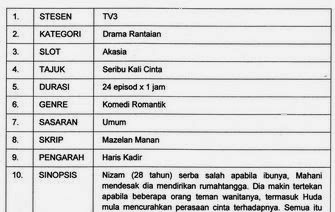
Draft format proposal untuk penulis skrip (contoh proposal yang digunakan oleh Mazelan Manan) yang fokus kepada butiran asas (seperti points di bawah) berdasarkan keperluan pusat penyiaran..
  • stesen - nama stesen penyiaran (rujuk wikipedia Senarai Stesen Televisyen Malaysia)
  • kategori - drama / tele-filem / drama bersiri / sitkom / dokumentari dsb.
  • slot -  nyatakan nama slot di bawah pusat penyiaran; atau cadangan nama slot yang baru
  • tajuk - nyatakan judul cerita
  • durasi - nyatakan tempoh; samada 1 episod X 90 minit, 24 episod X 1 jam, 25 episod X 30 minit; mengikut program pusat penyiaran
  • genre - nyatan samada drama, seram, thriller, komedi, dsb
  • sasaran - tentukan target penonton; samada umum (U), kanak-kanak (U), parental guidance (PG-13), 18SX / 18SG / 18PA / 18 PL (rujuk wikipedia Lembaga Penapis Filem)
  • penulis skrip - nyatakan nama penulis skrip dan hasil karya (prefer judul yang dah established)
  • pengarah - nyatan cadangan nama pengarah (setelah merujuk kepada pihak penerbit/produksi)
  • sinopsis - ringkasan keseluruhan cerita (2-3 perenggan)
  • perwatakan - nyatakan cadangan watak utama dan sampingan
  • sinopsis keseluruhan - nyatakan huraian lanjut cerita dari mula hingga tamat (6-10 m/s)
  • sinopsis episod - huraian setiap episod
  • kesimpulan - nyatakan kenapa cerita ini perlu diterbitkan 

Screenshot part of proposal format

Personally, I think, the format is OK (easy to read) but not enough convincing. Feel like something missing...


CONTOH 2


More info..dapat dari entry Zaini Kosnin


"Kebanyakan format proposal yang perlu disediakan oleh penulis untuk produser sama saja bagi semua televisyen kecuali RTM. Ini kerana sejak RTM memperkenalkan sistem tender, cara penyediaan proposal yang perlu disediakan untuk RTM haruslah mengikut kehendak mereka. Biasanya RTM ada menyediakan format tersebut untuk rujukan penulis dan produser setiap kali tender dibuka. Oleh yang demikian sebaik-baiknya untuk RTM, penulis dan bakal penulis ikut format yang dikeluarkan pada waktu tender dibuka." - Zaini Kosnin

Berikut adalah hasil "cedokan" dari blog beliau (simplified)..

  1. Maklumat Proposal - kategori, judul, stesen, slot, running time, tema, genre, konsep, sasaran
  2. Sinopsis / Storyline - detail cerita, subject yg jelas, main plot, sub-plot
  3. Watak & Perwatakan - senarai watak, calon/cadangan pemain watak
  4. Moral - mesej, moral and pengajaran of the story basically
  5. Cadangan Lokasi - yg bersesuaian (one of the reason that will cause high cost, end-up skrip masuk bakul)
  6. Sasaran Penonton - umum, kanak-kanak, remaja, etc.


Well, still look similar to the 1st ones..


Kalau aku cari contoh Hollywood pulak..

CONTOH 3

<<still searching..>>

, , ,

Surat Akuan Bersumpah

Wujudnya Surat Akuan Bersumpah adalah untuk mengisytiharkan hasil karya dengan tuan milik untuk kali pertama ataupun untuk semakan; secara rasmi.

Rujuk Akta Akuan Berkanun 1960 (shown below). Notice that, ada..
  • ruang untuk nama pengaku 
  • ruang subject matter
  • ayat/pernyataan sumpah
  • ruang tandatangan untuk Pesuruhjaya Sumpah 
Aku rasa, points di atas adalah basic info yang wajib ada dalam mana-mana surat akuan bersumpah. I believe, should be able to improvise and become valid.


Borang Akuan (seperti yang terdapat di dalam Akta Akuan Berkanun 1960)

, , ,

Surat Izin Terbit


Entry ini merujuk kepada blog Mazelan Manan mengenai draft/format surat izin terbit yang dibuat oleh penulis skrip dan dialamatkan kepada penerbit/produksi.

Pada aku, surat ini penting untuk menunjukkan persetujuan antara tuan punya hasil karya dengan pihak penerbit untuk meneruskan proses penyiaran.

Walaubagaimanapun, bagaimana tahap perlaksaan penggunaan surat seperti ini di Malaysia, tidak pula aku ketahu - mandatory ataupun optional.

Sebagai panduan, berikut adalah draft surat izin terbit yang dimaksudkan..

Nama penulis skrip 
Alamat. 
no. telefon. 
Emel 


Kepada:

Nama syarikat penerbitan 
Alamat.

Tuan,
SURAT IZIN TERBIT UNTUK DRAMA........ (tajuk dan kategori drama. contoh, TELEMOVIE ALFATIHAH ataupun drama bersiri NIGINA (26 episod x 60 minit).
Dengan segala hormatnya merujuk kepada perkara di atas. 
Adalah saya, .......................... k/p:.................... penulis skrip drama.....................dengan ini membenarkan pihak tuan untuk menerbitkan drama saya untuk siaran ..........
(stesen tv mana). 
Untuk makluman, skrip ini adalah hasil karya asli saya dan sekiranya berlaku sebarang perkara berbangkit mengenai penerbitan drama ini, saya akan bertanggungjawab sepenuhnya. 
sekian, terima kasih. 

Tandatangan 
Nama 
Tarikh
, , ,

Langkah Melindungi Hasil Karya


Aku jumpa blog Zaini Kosnin yang mencerita tentang kecurian hasil karya. Ada beberapa tips dan langkah diberikan beliau selepas berbincang dengan pihak peguam.

Langkah-langkahnya (with some adjustment) ialah..

1) Sediakan 2 salinan surat akuan bersumpah asal
  • sediakan ruang untuk ditandatangani oleh PESURUHJAYA SUMPAH (in English, COMMISIONER OF OATH) untuk menyatakan bahawa karya tersebut adalah milik kita
  • contoh Surat Akuan Bersumpah 
  • permbikinan surat ini adalah di bawah Akta Akuan Berkanun 1960 

2) Berjumpa dengan PESURUHJAYA SUMPAH dengan membawa
  • Kedua-dua salinan surat akuan asal untuk ditandangani dan dicop berserta tarikh
  • Hasil karya (iaitu skrip) untuk ditandatangani dan dicop berserta tarikh pada muka hadapan skrip
  • carian PESURUHJAYA SUMPAH, klik di sini [http://www.kehakiman.gov.my/Comissioner/carianCom.php]
  • PESURUHJAYA SUMPAH adalah samada Peguambela & Peguamcara atau Pegawai Awam atau Orang Persendirian yang berdaftar sebagai PESURUHJAYA SUMPAH dengan Mahkamah Persekutuan Malaysia 
  • maklumat kos sebenar proses ini boleh dirujuk terus kepada Pesuruhjaya Sumpah.

3) Salinan #1 (surat akuan dan hasil karya/skrip)
  • dimasukkan di dalam sampul surat 
  • dipos (POSLAJU) kepada nama dan alamat sendiri
  • simpan resit penghantaran sebagai bukti pos (rekod TARIKH dan MASA)
  • setelah tiba, simpan dan JANGAN BUKA SAMPUL

4) Salinan #2 (surat akuan dah hasil karya/skrip) untuk dijadikan rujukan.

5) Mula berurusan dengan pihak lain seperti penerbit, pengarah dsb.

Maklumat lanjut mengenai hakcipta ataupun copyright dikongsi oleh blog KartunisUbi yang disampaikan secara santai dan mudah faham. Secara formal, click Akta Hakcipta 1987 (as at Julai 2012) telah lama wujud.